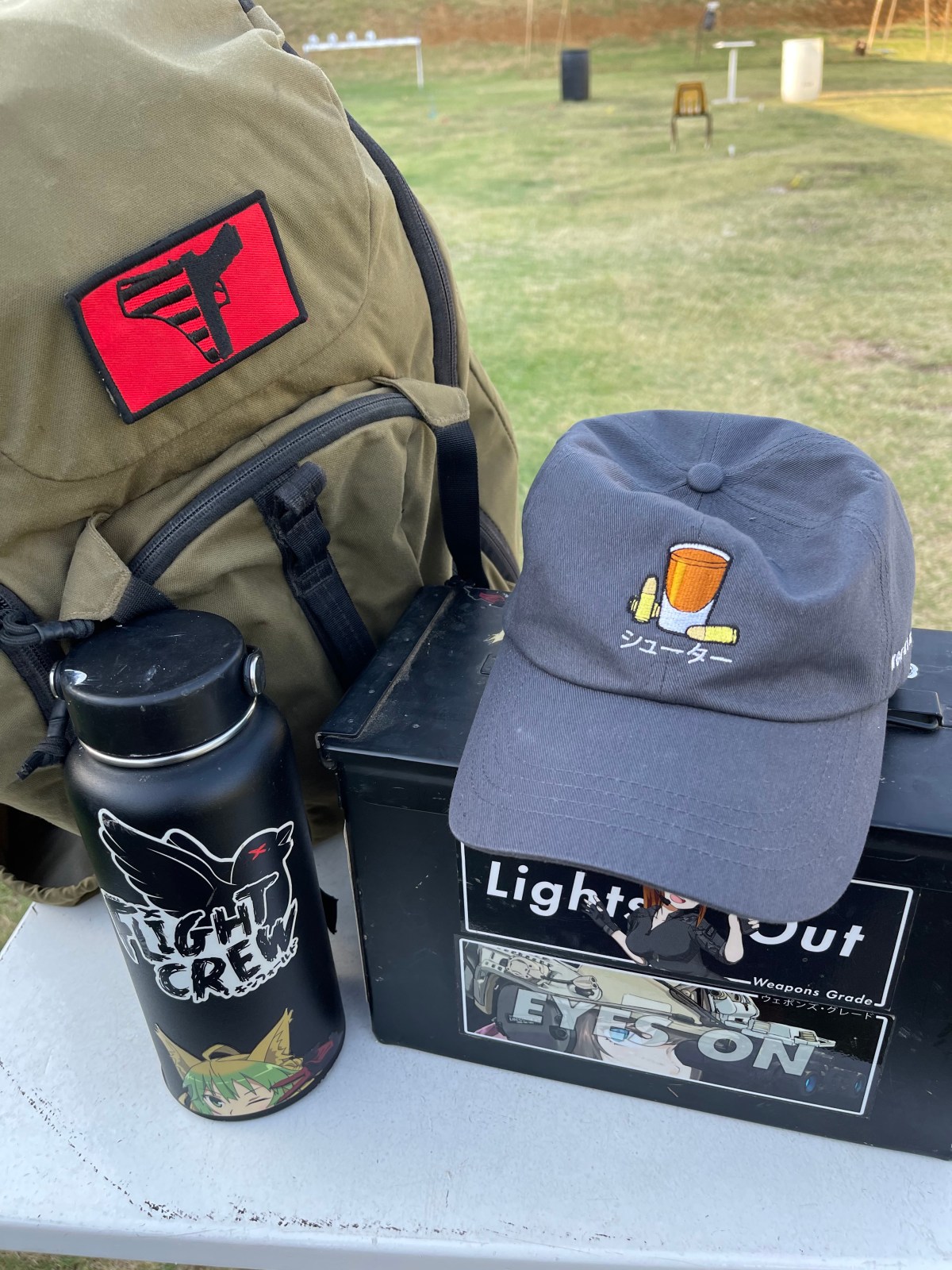
Chill Out: Staying Cool For Summer Matches

Ah, summer: that season where everyone gets to go outside and live their best lives – sweltering heat and bugs aside. This timeframe is also considered an on-season for many USPSA competitors as a lot of Level 2 and Level 3 major matches tend to be scheduled around now. As we start to shoot more during the summer months, these are just a few things I’ve seen some of the local shooters do that can improve your quality of life significantly.

Ah, summer: that season where everyone gets to go outside and live their best lives – sweltering heat and bugs aside. This timeframe is also considered an on-season for many USPSA competitors as a lot of Level 2 and Level 3 major matches tend to be scheduled around now. For those unaware, Level 2 matches tend to be a club’s bigger match (>6 stages, sometimes multi-day events), while Level 3s can be summarized by Area (USPSA interstate groups) matches and Nationals.

Most recently, I had the opportunity to shoot the Area 4 Championship match at Mission 160, my home range. Shooters have the option to opt to shoot all of the stages in one day, or split it up over two according to their preference. Regardless, everyone was sweltering as the Texas summer had begun. This weather entailed little to no cloud cover along with strong mid-90s heat (35C for our overseas readers) on average.

Pictured: Average Area 4 competitor moving on to their next stage (2023, Colorized)

An incident occurred on my second day of shooting where the ambulance had to be called, as one of the competitors suffered from heat exhaustion. Contingencies were in place and they were moved to the range’s air-conditioned building, where the competitor was cooled down and made to drink water. As we start to shoot more during the summer months, these are just a few things I’ve seen some of the local shooters do that can improve your quality of life significantly.

Hydration for the homies

Staying hydrated is usually the initial thought of many when it comes to the summer heat. The CDC recommends about 1 quart (1 liter approximately) of water per hour in the heat. Personally, I end up just packing a whole gallon jug and top off my water bottle as the day goes on. It is much better to have too much water than not having enough.
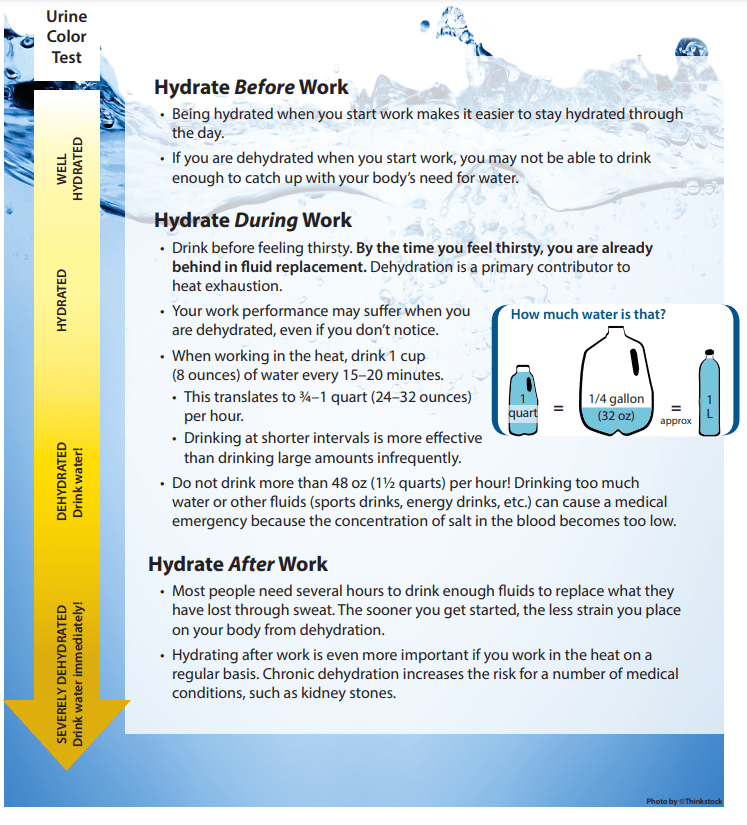
Source: Center for Disease Control

However, if you know match day(s) will be very hot, it is required that you drink water the day before is starts, as well. I have learned this lesson the hard way many times, where I didn’t drink enough water and ended up taking in some sort of caffeine early in the morning only to find myself developing migraines that were only exacerbated by the heat.

Electrolyte drinks/mixes and similar products (i.e. Liquid IVs) are also a good addition to have on the day of as well. Despite stages being “short” in terms of time spent, you are still shooting and moving in an athletic manner where you are outputting a lot of energy. That, along with taping and resetting stages all day under the sun, means you will be sweating a lot, losing both water and the salt that would allow your body to retain said water.

Finally, as a personal rule, I would stop consuming caffeine at hammer down. Caffeine is known to dehydrate you, and I have come to learn I am very susceptible to this. In the event that you find yourself overcaffeinated, stop consuming immediately and start consuming water. It might take a stage or two to get your nerves back, and you might pick up a migraine, but its better than having it with you the entire day.

Staying Cool includes Feeling Cool

This never really occurred to me until Area 4, where after the heat casualty incident, the range officers (ROs) and match staff were going around making sure everyone had water and were not on the verge of passing out. The ROs, being shooters themselves, had canopies and portable jobsite fans that kept them cool and were gracious enough to let us use thrm as well.

When I sat down on my ammo can, I could feel the air start to bake my skin. Subsequently, I also took note of my sweat and how heavy my breathing was getting, which are generally signs of not having a good time. I immediately looked for a portable fan to stand in front off while fanning myself and downing another bottle of water. Unfortunately, I didn’t have a towel or equivalent to help cool me off.

While keeping up water intake is good, keeping your skin cool is also something that is commonly overlooked. Usually, most people (myself included) would just apply sunscreen and call it good. However, the skin is an organ itself and anything adverse happening to it is something that cannot be ignored. It takes a bit for some people to start sweating and allow their bodies to cool off. If that is not possible, due to humidity/weather or otherwise, I’d recommend having pre-soaked cooling/ice towels stashed somewhere accessible. They’re generally more budget friendly and packable than a portable fan. Amazon has a pack of four for about 12 dollars, but you can pick them up from almost any sporting goods or department store. These are also good to have in the event of heat related emergencies.

Beat the heat!

Hopefully, the tips I have shared will keep you cool in this year’s upcoming season. If you have any tips for staying cool, please feel free to leave them down in the comments below. I am sure I have glanced over a few helpful tidbits, and Texas heat is most certainly different than heat in other parts of the globe. Good luck especially to those of you shooting Level 2 majors, area matches, or even Nationals. Stay cool, make ready!
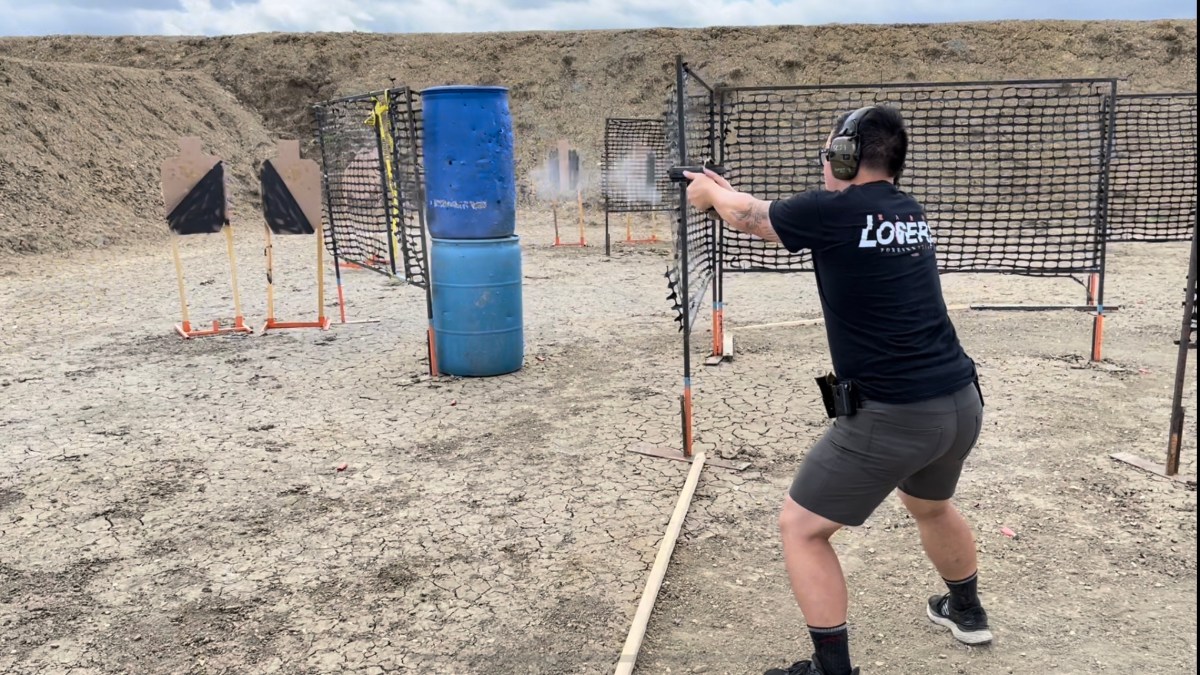
Self-Fulfilling Prophecies: Match Mentality As a New Competitive Shooter

“Soon” is the keyword: The “sooner” I see my target, the “sooner” my dot gets where I want the hits to be, the “sooner” I shoot, the “sooner” I get to the next position, the “sooner” I finish up this stage. One leads to another, and paired with an acceptance to push the envelope just a tick each time, all of a sudden I develop a weird sense of calm…and a weird sense of comfortably aggressive flow.

As a disclaimer, this blog post only serves to highlight noted observations I have as a novice level USPSA shooter. You, the reader, may be at a different skill level or different stage of your shooting journey. Thus, the lessons learned I will present should be taken with a grain of salt.

When I started shooting, my only exposure to competency was found through level 1 and 2 classes of instructors I found off of Instagram, and the local community I’ve had the pleasure of meeting through these instructors. One thing led to another and I found myself getting mixed up in an intro to competitive shooting class taught by Sean Burrows, a 3-gun shooter. After this class, I was able to get a feel for competitions in the outlaw matches hosted at a local range; however, I suffered a period of burnout where shooting was simply not as enjoyable as I once found it to be.

After some much needed self-assessment, I decided to bite the bullet and give USPSA (United States Practical Shooting Association) a try. My so-far 9 month journey has led me from being classified as a D-Class to a C-Class shooter. This progression is not necessarily amazing – maybe even slow, for some –  but that is where I currently am. During that time frame, however, I have found a much better understanding of shooting competency and marksmanship I only dreamed of previously.

The decision to learn more about match mentality was mainly because these “self-fulfilling prophecies” have hampered my performance at some of the local club matches I have shot; not only can they potentially set back skill advancement, but may also accelerate burnout. Other local shooters, also new to competition, have expressed that they encountered these same roadblocks, so I feel there is cause for concern for these as things that would turn someone away from the sport or prevent them from trying altogether.

What is Match Mentality

The term “match mentality” is something I encountered browsing through Ben Stoeger’s collection of practical shooting books. Ben, a world-renowned IPSC shooter, explains match mentality through an analogy where he equates the mental game to a computer’s operating system (OS):

The mental game is the OS through which we apply everything we know and do in practical shooting. Everything is tied into and runs through this mental matrix, including our technical skills and abilities, our learning style and practice methodologies, our memories, our emotions, our decisions, our motor skills, and our judgments. You can’t stop it and you can’t “solve” it. Everything in life affects it. But you can manage it, and you can use it to your benefit.

-Ben Stoeger

For those that may have come from a sports background, this OS mentality concept may seem familiar. Practical shooting is a sport and the shooters that participate are varying levels of athlete depending on their investment in the sport. In the USPSA-specific sense, facets of match mentality include the mental aspects that Ben described above, and other factors like equipment and weather.


I will focus primarily on the emotional and judgment aspects of my mentality that I have experienced, and how they manifested themselves in a match. While I have not been in this game long enough, some of the sentiments I have stem from these aspects and have been observed to be reflected among some other newer shooters I have shot with.

Prophecies

I define these “prophecies” as thoughts, feelings, or comments that I’ve heard or said myself at one point in my USPSA journey, and have had a subtle influence on my overall performance as a shooter. This is not an encompassing list, but rather highlights of ones that stuck out the most or others have said as well. I will divide them into three categories: pre-stage (coming to a new stage/walkthrough/before a run), mid-stage (during the run), and post-stage (after the run/walking to the next stage).

  • Pre-Stage
    1. “Wow, I hope I don’t get DQ’d (get disqualified) on this stage”
    2. “Oh man, I hope I suck less on this stage”
    3. “I’m just here to help tape targets and run the tablet”
  • Mid-Stage
    1. “Gotta go fast because others are fast” or “Gotta go slow and get my hits”
    2. “*slide locks back* Oh shit, I forgot to reload earlier”
    3. “Messed up the plan, got nothing to lose now”
  • Post-Stage
    1. “Well, that went worse than I thought it would”
    2. “I totally bombed that partial/no shoot, damn I suck”
    3. “Oh man, I hope I suck less on the next stage”
You can sense where it starts going downhill 

Personal Cues

Over time, I identified some of these prophecies and how they connect to an underlying problem in regards to my confidence and my attitude in shooting a match. They bring unnecessary baggage to a stage and occupy precious mental bandwidth when it’s time to perform. The following cues have helped reduce the white noise and keep my head in the game:

Experience breeds confidence. New experiences take time to learn and understand. The more you shoot matches, the more you understand what your capability as a shooter is. That does not mean signing up and shooting literally every match on Practiscore, but participating in matches along with supplemental dryfire/live fire can help develop a deeper understanding of what you can/cannot do and what to work on. This feeds into a cycle that would help cultivate a healthy learning mindset and better deal with adversity.

Each stage is a fresh start. Not one stage in a match is ever the same. To me, this helps address the issue of carrying baggage into a stage. Let us say that a match is a whole pizza. Yes, each stage is a piece of the whole pie; subsequently, your match standing does depend on your performance on a cumulative score of all stages. However, it is extremely difficult to eat the whole pizza pie in one go. Rather, taking it piece by piece is the more logical and viable route. In comparison, treating each stage separately can help keep your focus in the present, not the past or future.

“It’s not the plane. It’s the pilot.” This is a quote that comes up regularly when you watch Top Gun: Maverick or see the promos for it. However, it is true to a certain degree. When I started out, I was worried about everyone else’s performances, no matter their skill level. I placed an exacerbated amount of pressure to prove myself because someone was a certain class and/or ran certain equipment. No matter the equipment, the class, the stage plan –  it is all up to the shooter to make their hits.

“Comfortable aggression”

This seems like an oxymoron, but this phrase was something that came up when I was talking to Matt Chua, a local Carry Optics Grandmaster (GM), after I registered for my first Level II major match (which is in late September, write up to follow). I was throwing out some self-deprecating jokes and said something along the lines of “as long as I’m in the top 50%, I’ll be happy.” However, Matt brought it back to the ground quickly, stating that my goal should be “…to perform the best you can get, with hits as accurately as you can make them while being comfortably aggressive.”

At first I didn’t understand what he meant, and that last part sounded especially weird. Then the realization hit me when I was reviewing some of my match footage: because of a bad experience of “outrunning my headlights” in an Outlaw match, I was afraid of pushing the pace. Mentally, I had been equating a faster pace to crashing and burning.  If I didn’t get a hit or miss a reload, I froze up; I found myself walking to positions to hit things on the move to minimize red dot movement. I was overthinking way too much because I was afraid of messing up and not getting my hits.

My interpretation, which reflects my current mindset, is that I want to hit these targets as soon as I can see them. “Soon” is the keyword: The “sooner” I see my target, the “sooner” my dot gets where I want the hits to be, the “sooner” I shoot, the “sooner” I get to the next position, the “sooner” I finish up this stage. One leads to another, and paired with an acceptance to push the envelope just a tick each time, all of a sudden I develop a weird sense of calm…and a weird sense of comfortably aggressive flow.

Not too shabby, but still much to fix

Load and make ready!

Hopefully, I have provided some value to anyone that is looking into the practical shooting scene or to those such as myself that may decide they want to invest a bit more into the sport. It must be reiterated that your mileage may vary. Match mentality weighs an individual’s qualities heavily, so it is up to yourself as a shooter to know yourself and your equipment. You will probably be at a higher skill level, utilize different equipment, or some combination in the future that will force your match mentality to grow with you. Welcome the growing pains, don’t try to fight them.

Of course there is a lot more that goes into the practical shooting sport aside from mindset. I hope to share more of my journey with you all and am eager to hear more about everyone’s experiences in this pretty fun sport. See you all out on the range.

Additional Resources

Here is a short list of podcasts, books, and other resources that have helped me in my USPSA journey so far. It’s not a complete list, but it’s a start: