Footwear is usually something people don’t talk about when it comes to shooting. Generally speaking, a comfortable pair of sneakers can absolutely get the job done; I even used to run classes and matches in a pair of Chucks, which was a very bold move depending on the ground surface of the range I was at. Most of the outdoor ones had dirt, gravel, or some combination of the two. Thus, after slipping and sliding my way through Area 4, I figured it was probably time to get dedicated “range shoes”.
I took note of what everyone else was wearing: Altama, On, Salomons, Merrells. Trail running shoes are the norm in my locale. After asking some friends for their input, and a couple who were actually willing to let me test out a pair of their shoes, I finally settled on the Salomon SpeedAssault 2s.
Features
There are a few features of the SpeedAssault 2s I wanted to highlight very quickly. I did not own the previous generation of SpeedAssaults so I can’t speak for any changes between the two. Rather, I am only speaking on the few that I noticed from this pair.
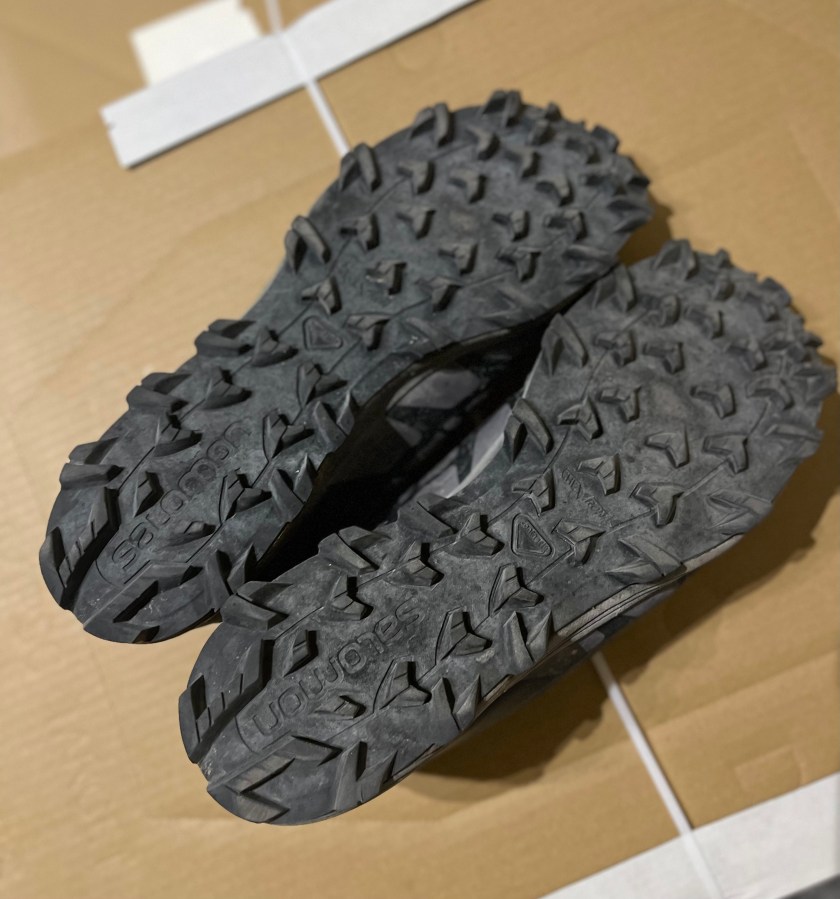
The tread is very grippy on soft dirt and gravel surfaces. While I am not necessarily the quickest shooter, the tread did give me enough confidence to being able to move and explode from position to position. I have not had an instance where I felt like I was gonna slip or fall as I was decelerating.
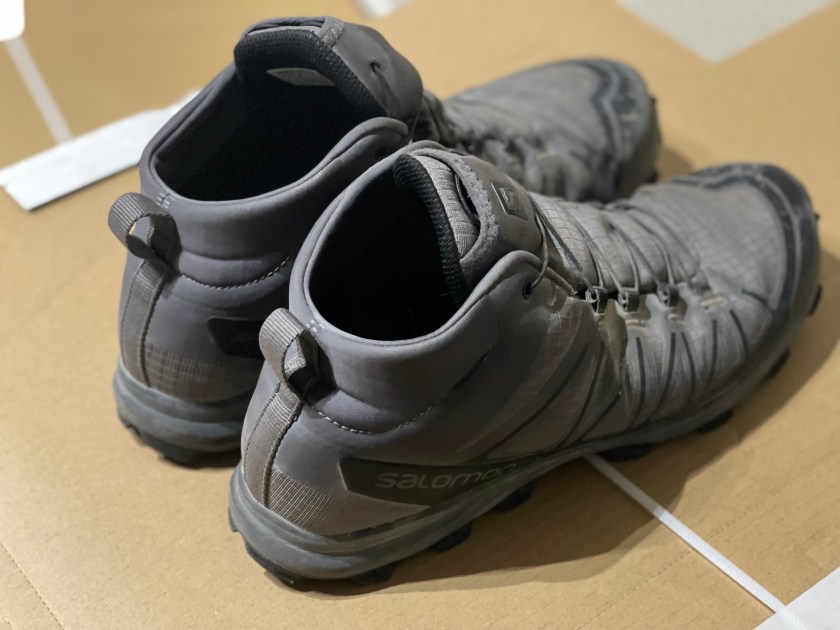
For laces, Salomon used their Quicklace system. This was the biggest draw to me over other trail shoes that have the traditional shoe lace system – as a match goes on, regular laces can be undone, and retying them to ensure security can get troublesome. The Quicklace allows for hassle-free adjustments on the fly.
Finally, the stretch heel just makes putting on and taking off the shoe so much easier. It doesn’t feel like I need to sit down or brace myself to wear these. After a long day, the last thing you want to worry about is falling and tripping over yourself off the range.
Fit and Finish
The SpeedAssault family of shoes are the military counterpart of Salomon’s SpeedCrosses, which have become a mainstay amongst trail shoes. The shoe’s design is a lot more muted, absent of the large “SpeedCross” branding and contrasting colors normally seen. Instead, it comes in three colorways: Black, Dark Brown, and Wolf Gray. I decided to purchase the Wolf Gray one because it not only looks very good clean or dirty, but also because within a friend group of five, four of us have dark brown SpeedAssault 2s. It helps during parties and gatherings when everyone is trying to figure out whose shoes are whose.
The fit was probably the biggest concern I had personally. Salomons are known to run on the smaller side. As a wide-flat footed American, that type of fit is the bane of my existence. Breaking them in was irritating to say the least. Depending on what socks are worn, it can affect how differently the midfoot feels. My Nike DriFit socks were much more generous versus my Darn Toughs at the beginning. The stretch heel does dig at the back of my heel at times. I have not gotten blisters, but the hotspots were hard to ignore.
The break-in period overall took approximately 4-5 weeks of constant everyday wear. After that point, the gripes I mentioned above quitely disappeared and the shoes became a mainstay with how quick, comfortable, and convenient they are.
Long-Term Review
I would like to write a follow up article to this after a few months, following the rest of my shooting season, to give a true impression. My only experience so far comes from breaking them in, going on a hike, shooting one match, and having a couple of range sessions. Ideally, I would like to give a picture of how these shoes fare in the competitive shooting environment in the long run. While they are reasonably priced in comparison to other mid-high end running shoes, I would like to hope that the durability matches price tag.
See everyone at the range! And stand by for part 2!
The MCX has been my go-to for almost all of the games we have attended. Even with it’s short barrel length and stock internals, it’s performed well in a variety of different field environments and rule sets. From zero-foot MED CQB in LA speed fields, to MOUT gameplay at George Air Force Base, to hill-to-hill engagements in the forests outside of Reno; the MCX has proven to be a sound choice for the “just one gun” approach, as its quick-change spring and in-spec MLOK slots make it possible to fine-tune its performance based on what I’m doing.
During the mid/late 2000’s, or my early days of my bbLARPing, I was obsessed with having different guns for different tasks. I “needed” the M16A2 for outdoor games; I “needed” the MP7 for CQB use; I “needed” the M4 for general pickup games, and on and on and on. As such I always had a shitload of unused airsoft guns lying around and taking up space. In 2020, after about a 3-4 year hiatus from “serious” playing, the decision was made to come back to the sport so the WGW team could play with our homies and customers that we had met through the company. At that point, I had gotten pretty tired of toy guns taking up too much space and had decided on buying just one gun.
SIG MCX fielded for the first time, January 2020. Accessorized with WOTG sling and Holosun HS403B optic.
Luckily for me, the Sig MCX AEG (with quick change spring) had just been announced for release… right around the same time some pictures started circulating of GEN Miller’s PSD of GS dudes armed with LVAWs. Having also just completed the Modern Warfare remake a couple of months prior, the MCX hype train was at full speed and I was an unwilling passenger. I called my local Airsoft Extreme store, put some money down, and had my MCX a few days later.
Since then, the MCX has been my go-to for almost all of the games I have attended. Even with its relatively short barrel length and stock internals, it has performed well in a variety of different field environments and rule sets. From zero-foot MED CQB in LA speed fields, to MOUT gameplay at George Air Force Base, to hill-to-hill engagements in the forests outside of Reno; the MCX has proven to be a sound choice for the “just one gun” approach, as its quick-change spring and in-spec MLOK slots make it possible to fine-tune its performance and capabilities based on what I’m doing.
The MCX can be accessorized to fit different environments. Full profile on left, optic only on right.
With regards to how the gun shoots… I’m of the mindset that all airsoft guns within an upgrade limit (ex., 400FPS) all do the same damn thing. I’m not the kind of person to get tied up in trigger response, rounds-per-second (who the fuck uses full auto anyways?), or tightbore barrels. The AEG fires when I pull the trigger and with good enough response, which are all that matter to me. In terms of “accuracy,” I have hit players presenting partial silhouettes out to ~150ft using the included downgrade spring (398FPS with .20) and .28 bb’s, which is way more than I could have asked from my old Marui guns out of the box. Since 2020JAN I have not changed out anything internally.
The only issue I have with the MCX is magazine fitment – it is super finicky with what mags fit (and fit well), and I’ve been lucky that the PTS EPM1s fit and feed decently enough. I’ve also had success with Elite Force “Dogs of War” metal midcaps and plastic boxset mags, as well. My particular MCX does NOT work at all with Evike, Amoeba and similar PMAG style “large” midcaps – my other friends with (later DoM) MCXs are able to use these mags without issue.
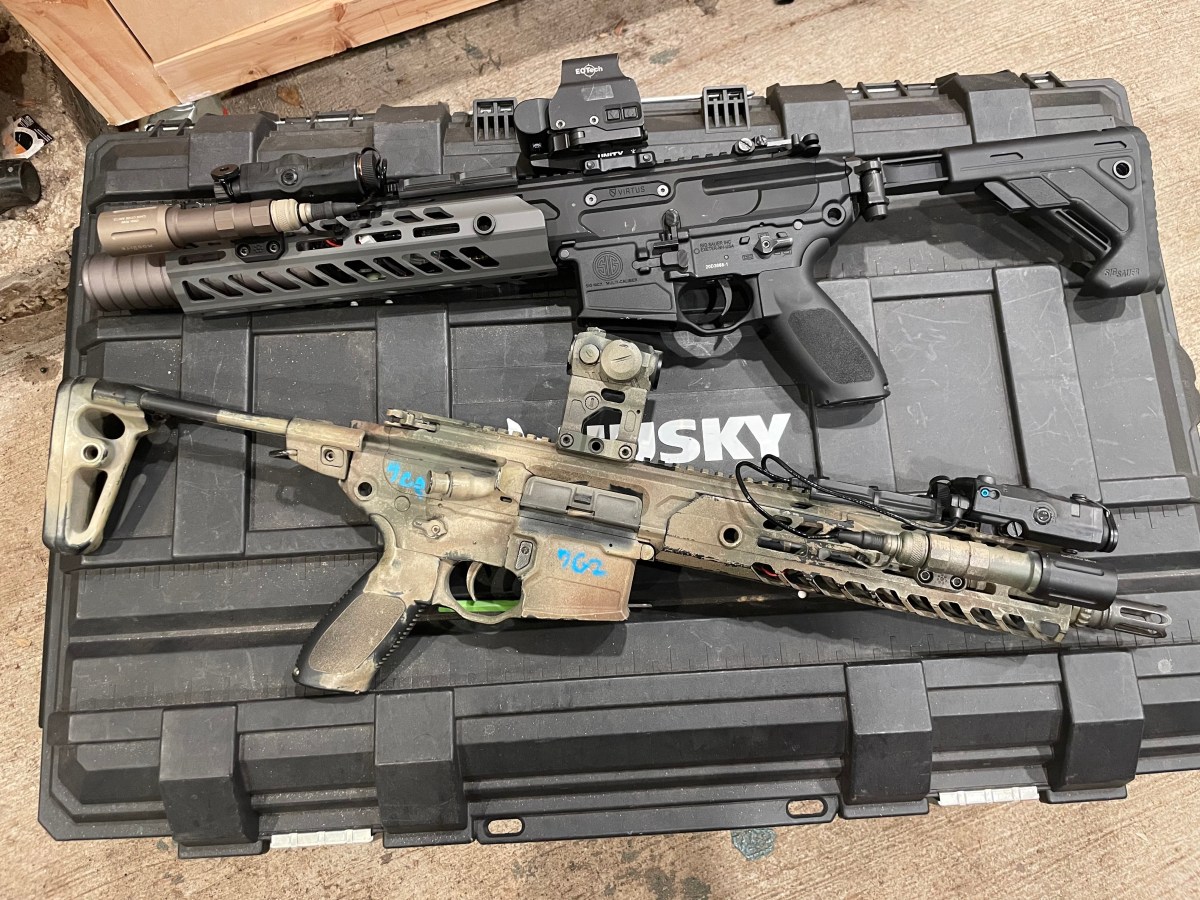
Author’s personal MCX at bottom; top MCX has authentic SIG handguard and stock.
I also throw on my EoTech G33 magnifier/Unity FTC mount and L3 PEQ-15 as the situation dictates. The in-spec mounting holes and rail slots allow authentic weapon accessories to be used. Additionally, the MCX is compatible with actual SIG rifle stocks and handguards, though battery fitment/placement may vary depending on which one is used.
At its most basic level, the MCX is just another version 2 gearbox AEG that takes M4 mags – it does, however, come with some much-needed hardware updates for the 21st century. While they may seem minor in the grand scheme of things, the discerning end-user will find these tweaks very welcome as it allows the MCX to cover all the bases that most airsofters would need for general-purpose use.
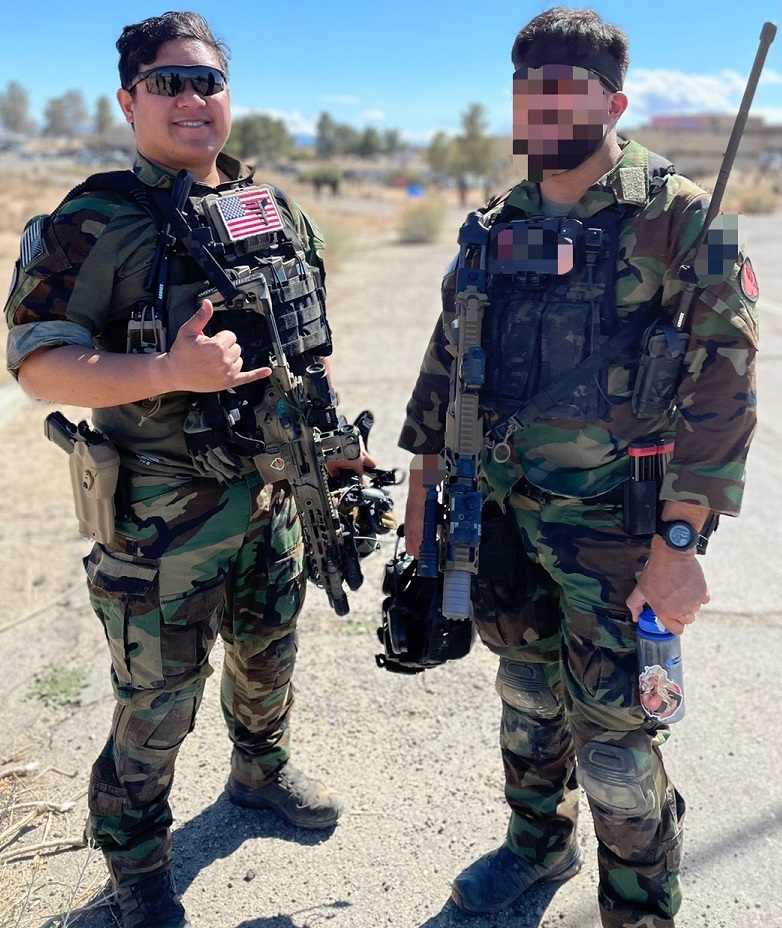
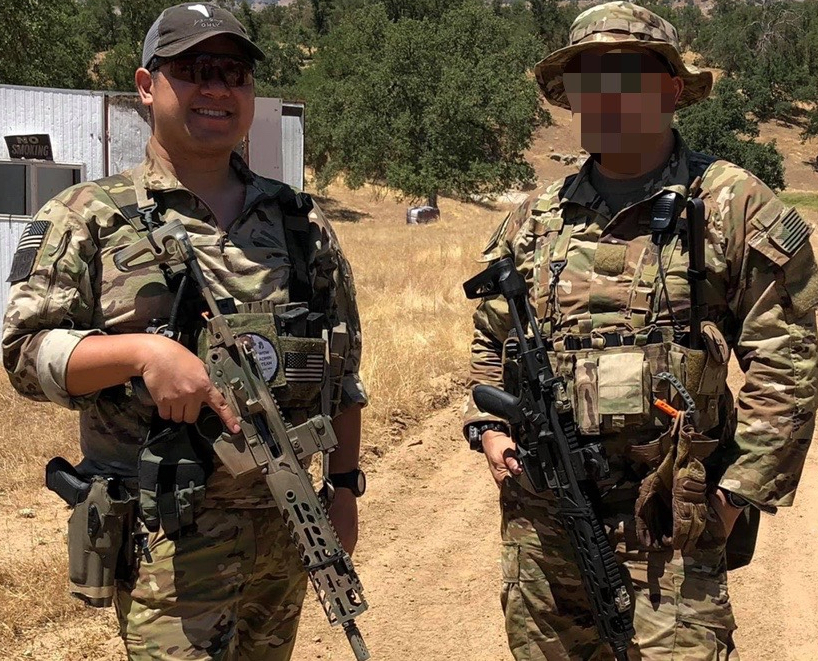
Author and his airsoft team, the “Ghosts” est. 2003. The MCX was quickly adopted as the team “standard” gun
In short, any of these listed rifles would cost you near if not more than a premium factory AR such as a KAC SR-15, Noveske Gen 4, or a Geissele Super Duty. It’s important to remember that the rifle we are about to build is inherently a rack-grade milspec M4, with the exception of the upper receiver profile. I just cannot find any way to justify these prices aside from “hype.” I’d hate to see people turned away from a fun, historic rifle like this due to hypebeast gatekeeping.
Quick disclaimer: I have literally no relationship with any of the companies or manufacturers I am going to mention in this article. Nobody knows who the fuck I am, I’m just a random shittalker on the computer.
The main reason I wanted to make this article is because in the past 5 years or so, the retro AR scene has exploded. Several notable influencers (you know the ones) in the online gun sphere have released content regarding rifles like this, which is awesome, but it also drives a certain not-so-cool element. I assembled my first “retro” in about 2016, while I was still a somewhat poor gun store employee and student. My rifle was based on the Model 727, but did not feature a mounted optic or weapon light. This rifle maybe cost me 5 or 600 dollars to make, if I recall correctly.
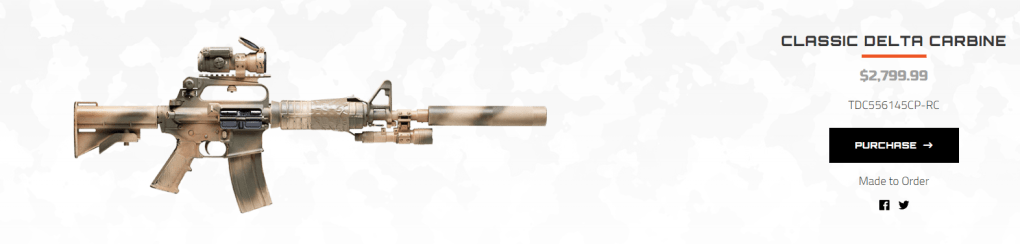
Recently I have noticed a trend of certain businesses marketing for retro AR parts or outright to-order builds. Let’s take a look at a couple listings.
Type-A Rifles. This listing includes the Aimpoint PRO, but not the suppressor or WML.Of note is that this particular upper is a hybrid of an A2 and Noveske Gen 4 profile, which is unique, but wasted seeing as there is no NSR handguard to mate to it.
To make matters worse, the next screenshot is from a video about doing a CAR-15 home build.
I literally don’t know how you can make this build cost over $4k. Perhaps the Aimpoint 3000 was most of this cost.
In short, any of these listed rifles would cost younear if not more than a premium factory AR such as a KAC SR-15, Noveske Gen 4, or a Geissele Super Duty. It’s important to remember that the rifle we are about to build is inherently a rack-grade milspec M4, with the exception of the upper receiver profile. There is no reason you should think you need to pay this much for this build, and I hate the idea that these companies are making people think this is what they cost. I hold no ill will to anyone at these companies. I’m sure the dudes at Type-A make a great rifle. I have met several of the dudes at Noveske, I appreciate them greatly, and they also make a great rifle. I just cannot find any way to justify these prices aside from “hype.” I’d hate to see people turned away from a fun, historic rifle like this due to hypebeast gatekeeping.
Let’s go over my particular impression build, and I’ll break down the costs and include sources for components as best as I can. I’ll include some substitutions as applicable. Don’t forget – have fun with your build!
Not Clone Correct Bro!
CAR-15 a la Duke
My particular CAR-15 build is based mostly on the rifle as seen in the Black Hawk Down film, with some exceptions. This is because fitting optics such as the Aimpoint Comp M2, PRO and ACO are widely available and are not too expensive. I’d rather leave true vintage optics to people who will care for them appropriately. I will also be using an alternate WML solution since I hate duct tape and janky tape switches. I feel that this setup still captures the “soul” and look of the real McCoy, while keeping it mostly in line with modern standards. Also, fuck it, it looked sweet in the movie – Call it a cope, I don’t care.
UPPER My upper receiver was purchased assembled with no barrel from Tony’s Customs a little over a year ago. My barrel is a BCM 14.5″ 1:7 SOCOM profile that I cannibalized from a SOPMOD build. Mine features an “F” marked FSB, the most accurate one is the Non-“F” marked one. The main difference is the height of the front sight housing. This could potentially cause issues with zeroing for elevation if you can’t get the front sight on the “F” marked item low enough. If this is an issue, for you, you can replace it with a shorter front sight blade. This barrel has a pinned and welded BCM A2X flash hider to reach non-NFA length. Any 14.5″ Gov profile barrel will have the right look, with a phosphate finish being the most authentic. You could also go for the skinny profile variant if you want.
Handguards are the “skinny” plastic carbine handguards, not the more common “fat” M4 handguards. My BCG is a Noveske-marked Rubber City Armory black nitride BCG. I just like black nitride BCGs, I use them in all my rifles. Use whatever good-quality BCG you prefer here. Again, phosphate finish is the most authentic. A standard charging handle is most appropriate, use something else if you like. A PRI or VLTOR would probably look pretty dope. I’m currently using a BCM Gunfighter. Mounted in the carry handle is an A.R.M.S. # 2 carry handle mount. On that mount is an Aimpoint PRO in a Vortex Tactical 30mm Low Mount. The WML solution is an Impact Weapons Components TMC Scout Light Mount with ring for 1″ lights, bearing a SureFire G2x 600 lumen LED light. For my purposes, this is better in every way than a janky duct tape and barrel band setup for a 60 lumen light, but you may disagree. With the optic and WML mounts, go ahead and get some blue Loctite on all that shit.
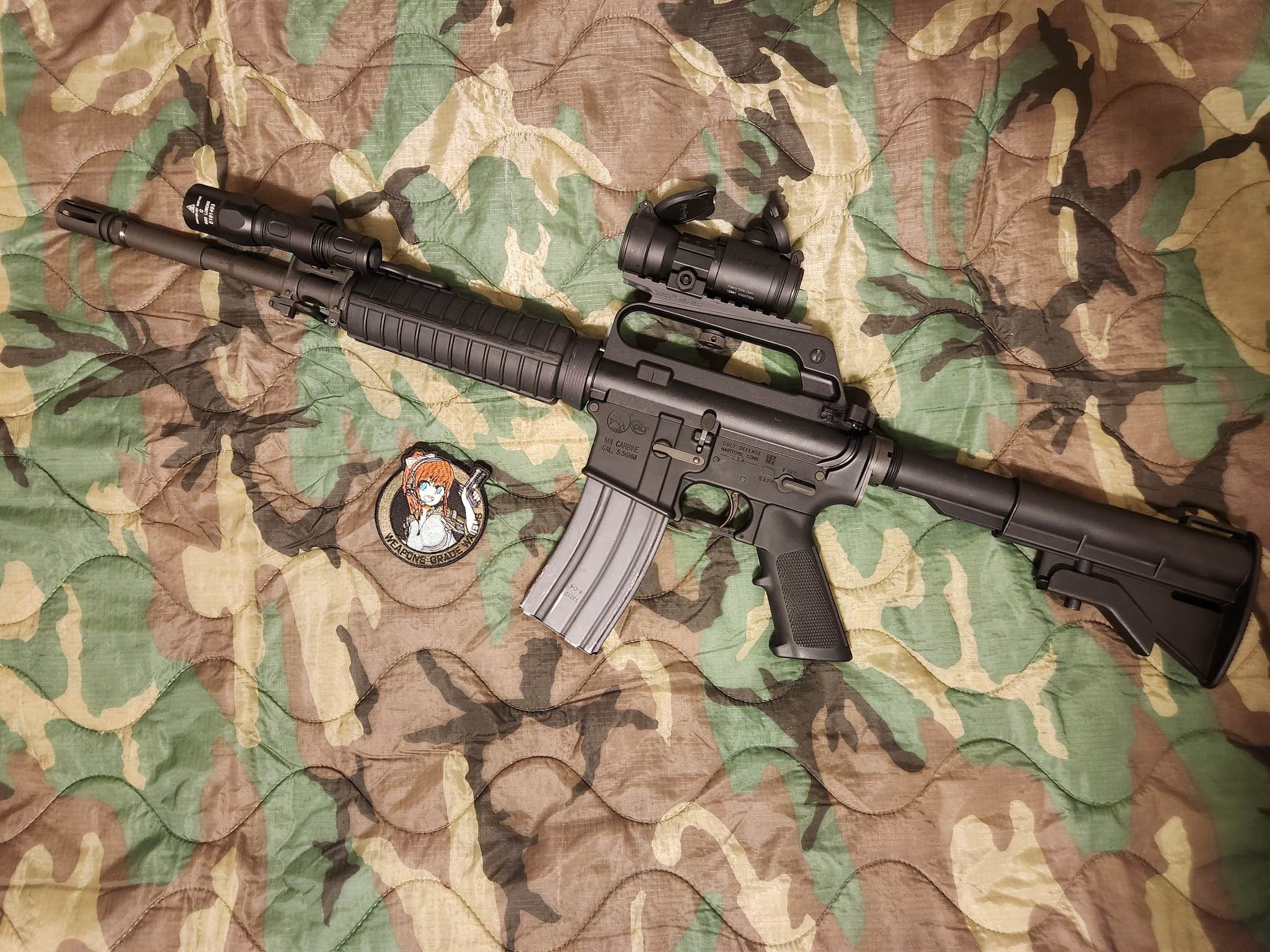
LOWER The lower is extremely simple. Any milspec lower will fit the bill, the only slightly odd part is the Colt FiberLite stock. My build features a reproduction version produced by B5, I promise nobody will notice the difference. Keep the stock A2 pistol grip. Trigger is fair game, I know people get very particular about them. I tend to use enhanced milspec triggers, such as the ALG QMS. My particular lower is from a Colt LE6920 and has the “M4 CARBINE” rollmarks. It’s not accurate, but it says “Colt” on it. For fun, you could use one of the PSA M16A2 marked lowers.
LIST FORM + APPROXIMATE COST Some of these options may be hard to find our out of stock at the date of publish. We all know how the supply chain for AR parts has been for the past few years. I’ve subbed out some of my specific components for some more convenient ones that achieve the same result. These options are for the least amount of fiddling around with individual small parts.
(Be sure to select “F” Marked FSB, Handguard Cap, and Delta Ring. There’s contention about the “F” marked FSB vs the unmarked one, long stories short, the “F” will work just fine in most cases, and if there are truly issues zeroing for elevation, you can purchase a shorter sight post. If you want to avoid this altogether, purchase a non-“F” marked FSB. If you want the whole thing to look a bit more authentic, go for a phosphated barrel such as from BCM or a Noveske CHF if you’re really boujee. )
Tony’s Customs C7 Upper Receiver – $190 (This will likely be the hardest part to get. This is a very small business, but they are responsive to communication. Send them an email if you have questions concerning availability.)
Aero Precision M4 “Clone” Complete Lower Receiver – $255 (This lower omits the Aero logo on the right side of the magwell, and has faux Government Property markings. It says “M4 Carbine” on the left side.)
You could do this cheaper if you really needed to, I only listed parts I have experience with. If you’re comfortable sourcing all your stuff from PSA, go ahead.
If you’re averse to assembling your own rifle, or simply would rather trust it to a manufacturer, PSA now offers a 723 style carbine through their H&R line, fully assembled, for $1100. This one does feature a pencil-profile barrel.
“Hey, who’s hungry?”
Everybody knows the jambo
Alright, now that all the technical bullshit is done, and you have a CAR-15 of your own, it’s about time we talk about shooting the fucking thing! Come back soon, in part 3 Mark and I will give you some insight on how this certified hood classic worked out at LMS Defense’s Practical Carbine course, where we took the good ol’ CAR-15 from muzzle shots out to 600yds and everywhere in between.
2005 – I remember I was at my grandma’s house after school watching some afternoon cartoons when a commercial came on. It started with a LucasArts flash, and I was an avid Star Wars fan, so my attention was immediate. Revenge Of The Sith was due out soon, and I clung to anything I could get.
What I saw was Star Wars, but not in a way I had ever seen before: intense first-person helmet-cam combat in ambushes interspersed with the heavy breathing of a stressed Commando. I knew this was something different, something I’d never seen before.
2005 – I remember I was at my grandma’s house after school watching some afternoon cartoons when a commercial came on. It started with a LucasArts flash, and I was an avid Star Wars fan, so my attention was immediate. Revenge Of The Sith was due out soon, and I clung to anything I could get.
What I saw was Star Wars, but not in a way I had ever seen before. I distinctly remember the ad campaigns for this game showing a sense of tension and even fear I had never seen from any media from the franchise: intense first-person helmet-cam combat in ambushes interspersed with the heavy breathing of a stressed Commando. I knew this was something different, something I’d never seen before.
The Boys
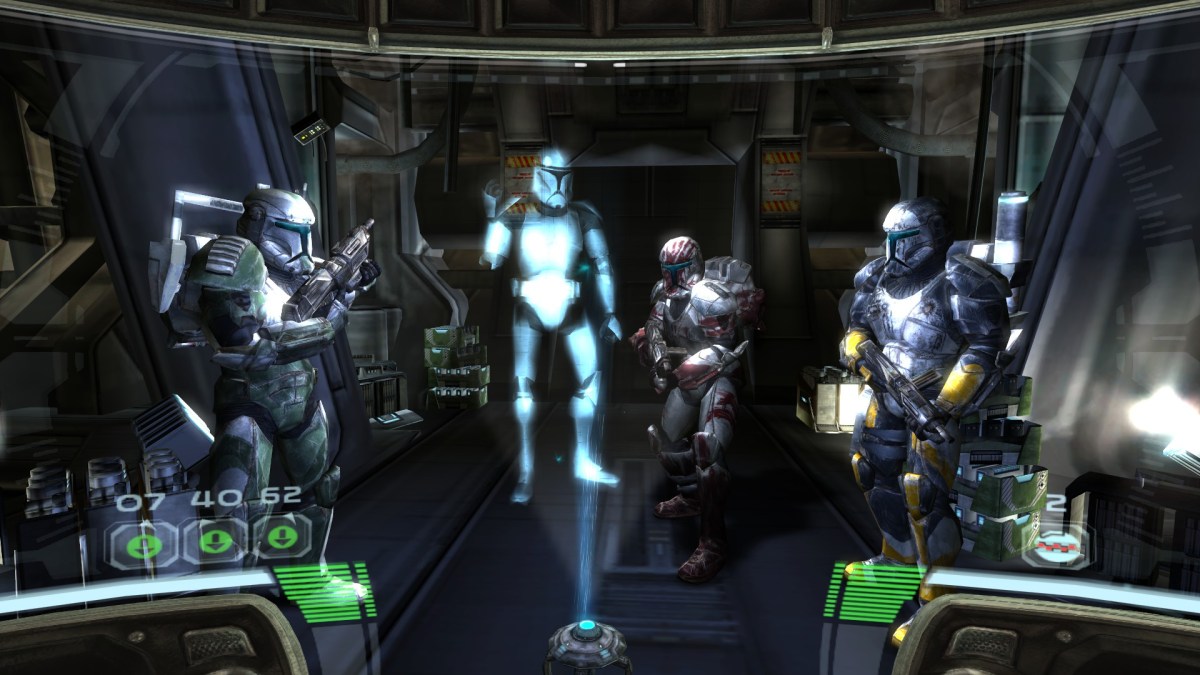
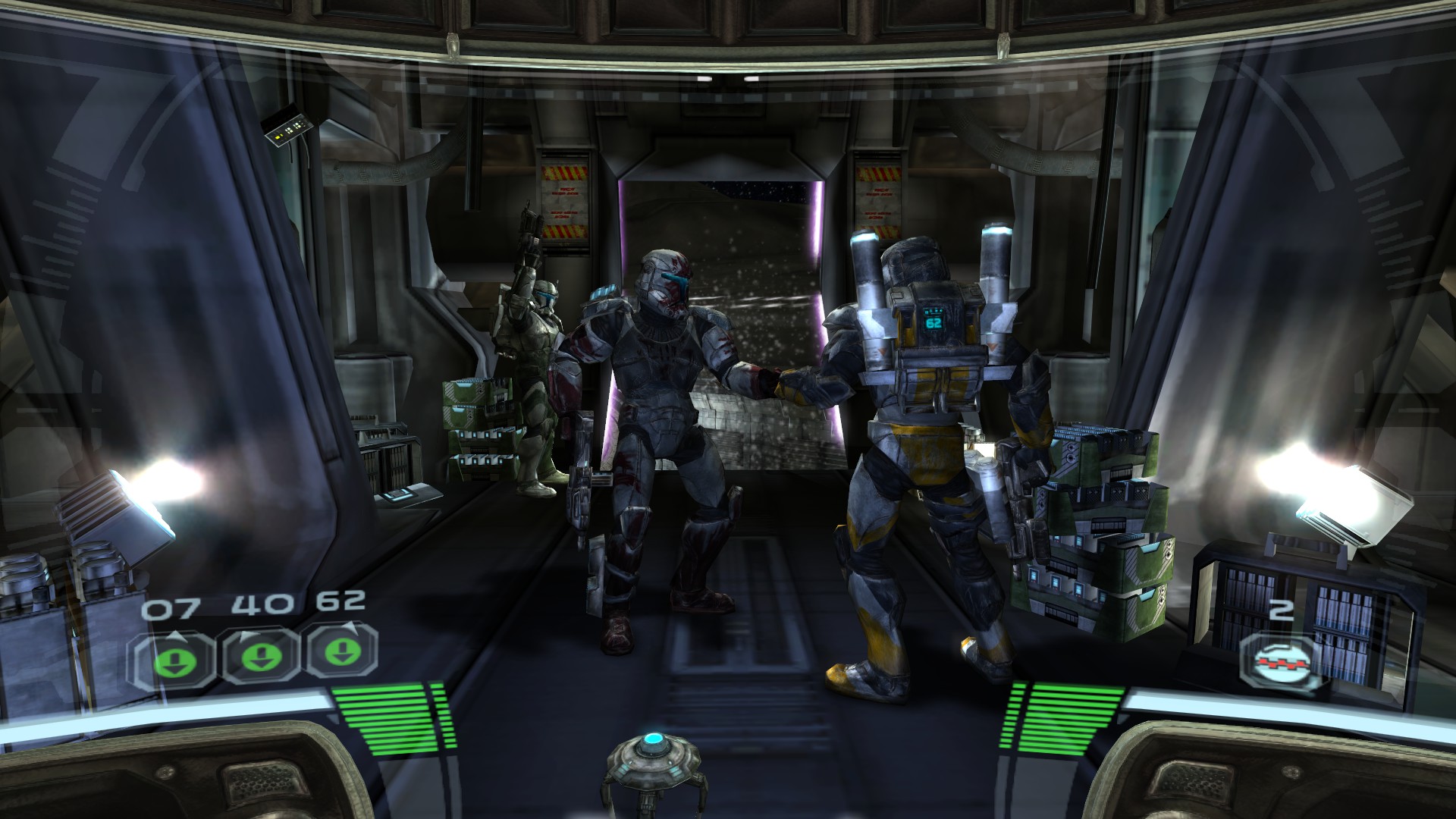
Delta Squad in the team room
Released in March of 2005 for the XBOX and Windows, Star Wars: Republic Commando is a “tactical” FPS set in the Star Wars universe during the time frame of the Clone Wars. I’m not going to dive too deep into the narrative, but lets take a look as to what makes this title tick.
As soon as you launch the game, you are greeted by your boys, Delta Squad, backed by the vocals of a Mandalorian choir. The game spends a few minutes getting you up to speed. The basics: you are a Clone Commando in the Grand Army Of The Republic, designation RC-1138 or “Boss,” and leader of Delta Squad which is made up of three additional commandos.
RC-1140 “Fixer” Fixer is the teams technician and slicing expert. He is described as “pure and uncomplicated” soldier, and Four-Oh is a “by-the-books” type of Commando that will recite policy and SOPs verbatim. His favorite weapon is the wrist gauntlet vibroblade. Badass.
RC-1262 “Scorch” Scorch is the “class clown” but he’s got it where it counts. Six-Two is the demolitions and heavy weapons expert of the squad, and is always the first for a clever quip or to volunteer for a bit of “radical restructuring.” His favorite weapon is the anti-armor launcher. Enemy go boom.
RC-1207 “Sev” Sev is described as a “fierce hunter” and it’s clear from first glance he is not only very capable, but very enthusiastic about his work. The crimson smears of paint on his armor, combined with his passion for his work, have brought forth a very important question: is it real blood or not? Oh-Seven’s favorite weapon is the sniper rifle.
Each Delta’s personality is unique and distinct from the get-go. Boss is voiced by Temuera Morrison himself, who played the role of Jango Fett and the Clone Troopers in the films, which adds a hefty amount of authenticity to the character and the experience overall. The squad’s interaction amongst themselves really does feel like that of professionals who have lived and worked together for a considerable amount of time – in this case, for their whole lives. The dialogue almost never feels contrived, or out of place.
Buckets On; Hearts Gone
Grab your buy’ce
Your first duty as Delta Lead will be partaking in a covert op in the backdrop of the Battle Of Geonosis to assassinate a Geonosian HVT. Each Delta has been inserted via separate methods as a failsafe, to ensure the whole squad doesn’t all go down in one gunship.
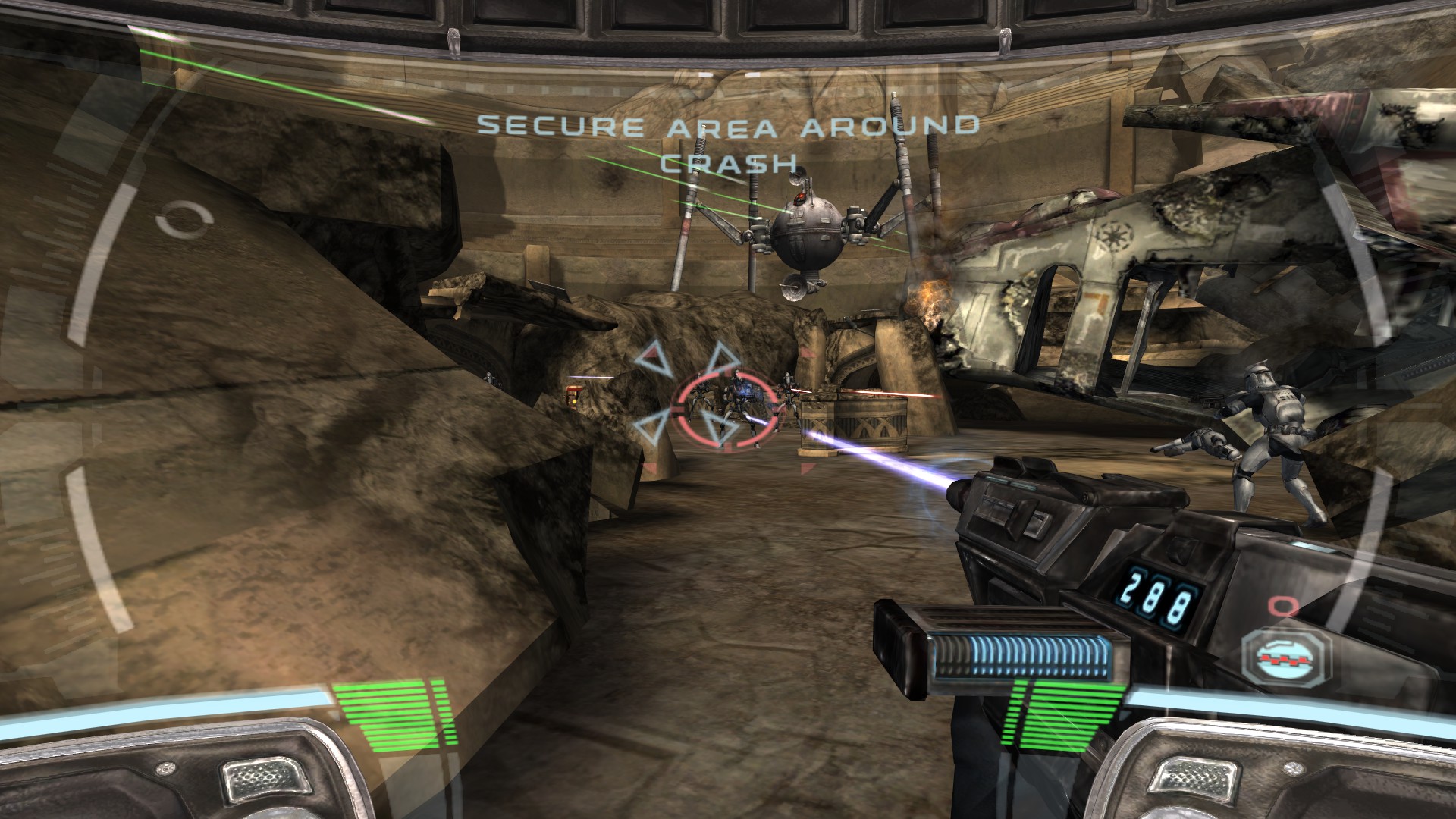
As you make your way through the the frontline trenches, you’ll become acquainted with your basic equipment and controls. This game handles more or less like any standard FPS of the time; it’s simple to pick up and run with. The Heads-Up-Display within the helmet of your Katarn armor will give you information as to your health and shield status, objective location, and squad status. Weapon status is indicated by readouts on the weapons themselves. Nearly every piece of info the game will give you is in a diegetic manner that Boss himself is seeing. Encountering your first enemies will get you torching off some blaster bolts with your Blas-Tech DC-17m Interchangeable Weapon System, or “Deece.” As the name implies, the Deece is modular, and with quick component swaps will perform as your workhorse assault rifle, precision sniper system, and light anti-armor launcher all in one package. Especially of note – When’s the last time you can remember using iron sights in a Star Wars game?
DC-17m IWCS in action on Geonosis
You are also issued a DC-15s Sidearm Blaster, which is fairly plain as far as handguns go. Accurate and packing a fair amount of punch, it has a recharging system which ensures you’ll never be caught without ammo for a fight. It can fire eight shots in rapid succession before needing to recharge, so I always imagined this to be analogous to iconic Delta Force 1911s, or the MEUSOC 1911 employed by the Marine Corps; whether that was intentional or not, who knows.
You can also pick up various small arms from fallen enemies throughout your missions: these include a Wookie rocket launcher, Trandoshan shotgun, and even a belt-fed MG. The arsenal is rounded out by a few different grenades, including the classic Thermal Detonator, flashbangs, and an EMP grenade which stops clankers in their tracks. Throughout your tour, you’ll be going toe-to-toe with various TradeFed battle droids, as well as Trandoshan slaver and mercenary chakaar. If you want to live to operate another day, it’d be good to become familiar with the strengths and weaknesses of your available equipment.
DC-15s Sidearm Blaster. Two Galactic Wars?
Working your way into your target location, you’ll pick up your squadmates one by one. Here is where you’ll begin to realize that the most effective weapon at your disposal is not the Deece in your hands, but your team. You are able to give your squad simple commands, such as taking up a sniping position, setting up a demo, slicing a terminal, or aiding a fallen brother in need. You can also decide the general manner in which they behave, with the “search and destroy” command prompting them to be aggressive and semi-independent of your direct command, or having them form up while you take point and call the shots.
The Deltas are able to think for themselves. They’ll seek cover as appropriate, use available healing stations if needed, or utilize grenades and the various Deece attachments. I’ll notice that if I’m performing a task, such as setting up a demo shot, the squad wont simply stand and watch me work. They will spread out, watching different sectors from positions of cover.
Delta Squad executes a breach and clear. Notice Fixer provides rear security as lead shooters make quick hooks in to their corner points of domination.
Each Delta has a particular skill or equipment they “specialize” in, but this does not translate to any difference in gameplay: each brother is just as proficient in each skill as the next. It would be nice if there was a perk to using each Commando to fill specific tasks, such as Sev having more accuracy or a higher fire rate when in a sniping position, or Scorch having a reduced time to set up a demo or recover an enemy mine. I believe this may have been omitted in order to keep the decision making more fluid and on-the-fly, rather than getting bogged down while in a firefight. This is a “tactical” shooter, but it isn’t Star Wars: Raven Shield. Maybe it could be compared to the simpler Rainbow 6: Vegas games in terms of that side of the gameplay.
Much of the campaign is designed around the effective use of your squad – you simply cannot play this game like Three-Eight is a one-clone army. Your energy shields and guns will get you far, but at the end of the day, there is a reason there’s four of you. The very best and most engrossing parts of the campaign are when you are setting up an ambush or a counter-assault with the resources you have around you. Is there a place you can set up a proximity mine and lure your enemies through it? Maybe there’s an E-Web emplacement nearby, but you need to demo some rubble to get a clear line of sight. The tactical gameplay keeps you on your toes, and keeps you re-assessing what resources and positions of advantage you can exploit. I can tell you that even with all the advantages you can muster, taking down a Droideka dispenser under withering fire is going to be a huge pain in the shebs.
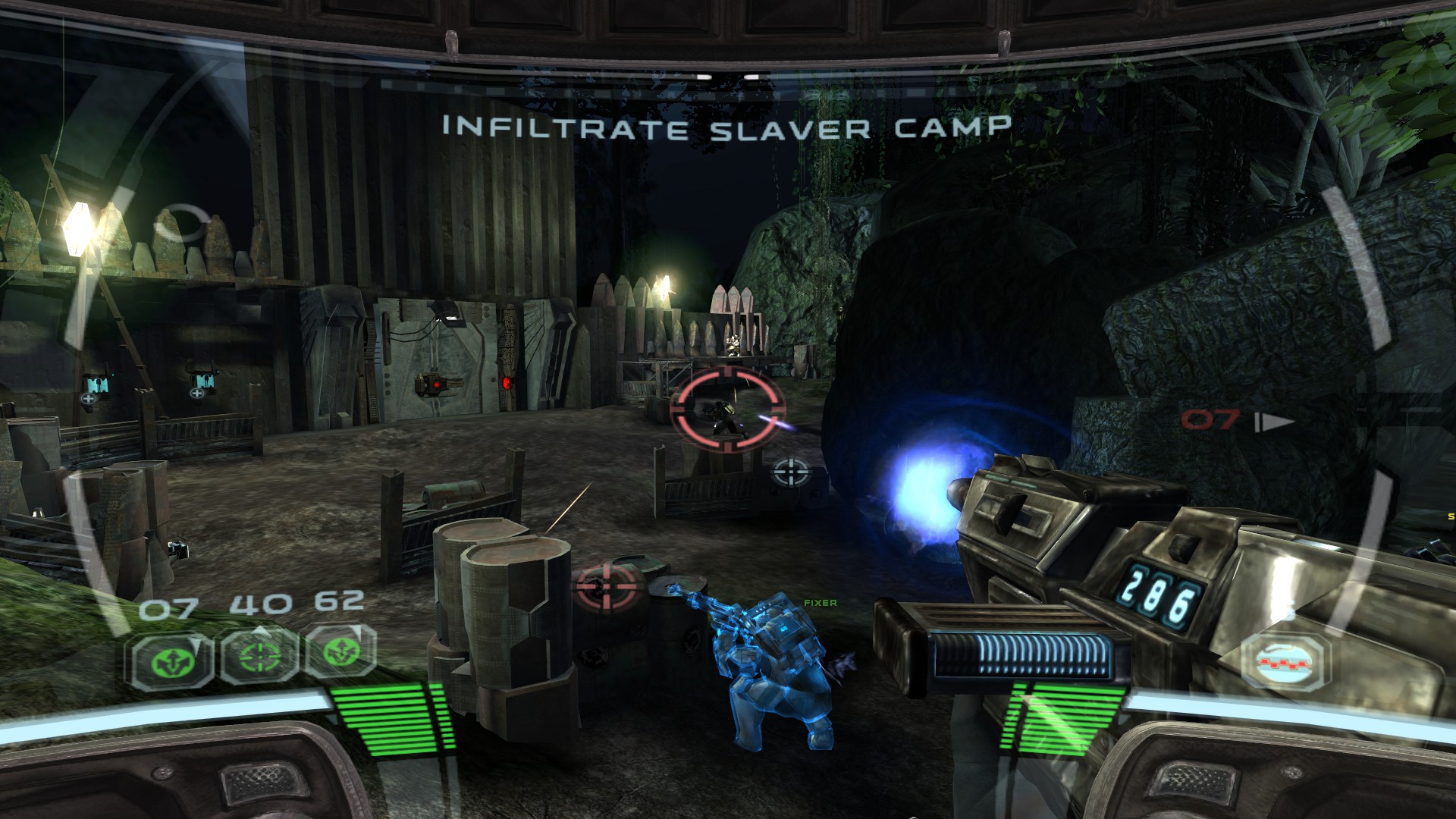
Setting up firing positions in a Slaver Camp takedown.
A Galaxy Far, Far Away
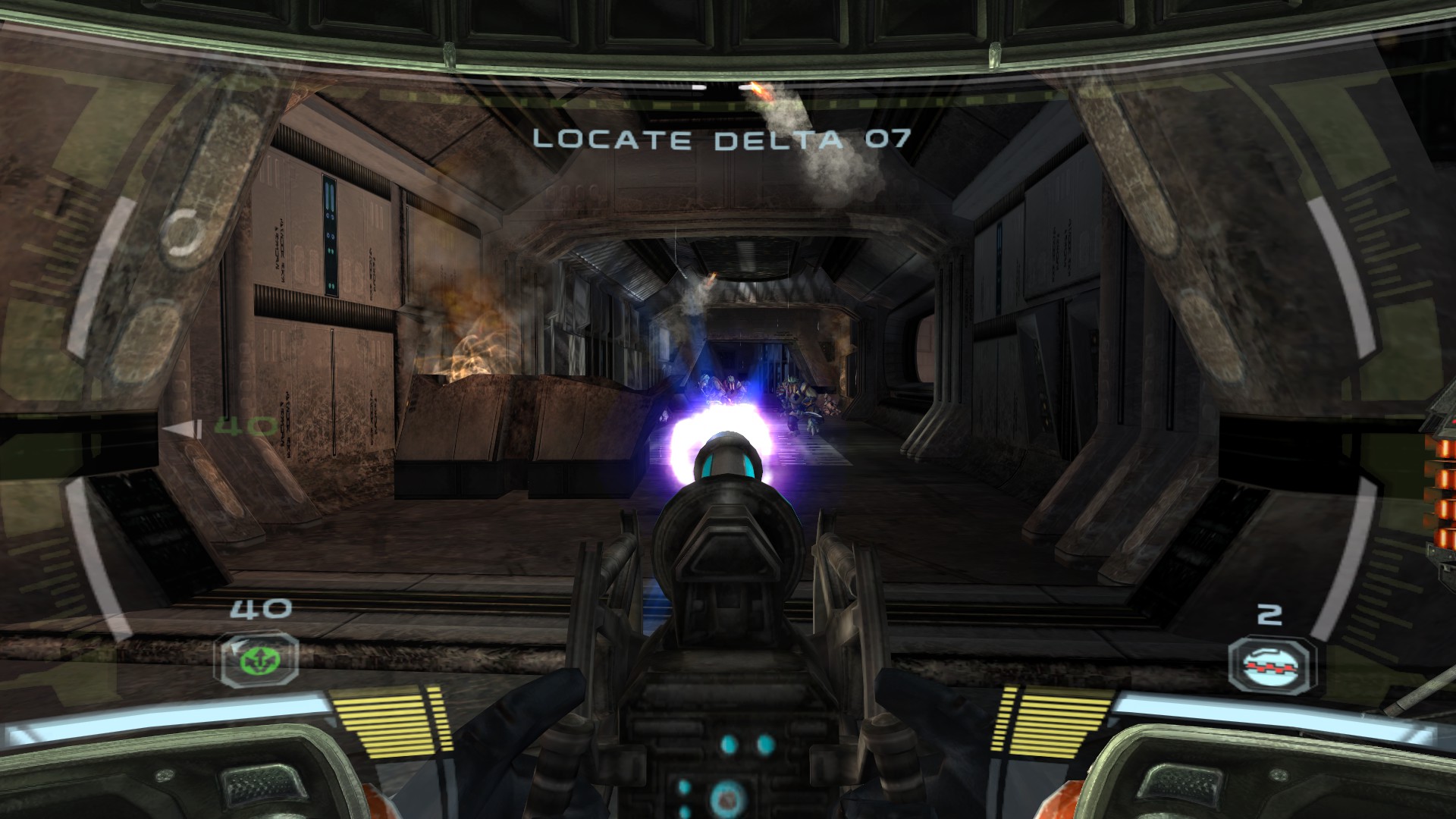
Republic Commando will have you participating in several diverse AOs. From the red-sand canyons of Genosis, to a VBSS mission on a derelict Acclamator-class Republic Assault ship, and finally the jungles of Kashyyyk, from the depths of the Shadowlands all the way up in the Wookie villages high up in the Wroshyr trees; each environment is well-detailed, and varied in appearance. There are stark stylistic differences even in similar locales, like Trade Federation and Republic starships. None of the levels got too repetitive to me before I found myself in a new one.
Slaver patrol camp in the Shadowlands of Kashyyyk.
Sound design is very authentic to Star Wars, and uses familiar effects that will make you feel at home in the overall universe. Also present is a mix of John Williams’ score for both the original trilogy as well as the prequel films, and original tracks made just for Republic Commando – both intermix seamlessly. The original tracks make frequent use of male choir singing in the Mando’a language, intense percussion and brass elements, as well as a goddamn didgeridoo. This is in keeping with the presentation of Mandalorians being based on New Zealand and Maori cultures, thanks to Temuera Morrison being the template for them. Give it a listen in the link below.
Graphically, the game is very competent. The team managed to strike a balance between military grit, typical Star Wars presentation, with a mix of almost cartoonish stylization, and manage to pull it off with great success. You’ll see some absolutely massive Wookies defending their homes, and face off with the intimidating profile of the B2 Super Battle Droid.
As the game was a 2005 XBOX title ported to PC, the standard graphics suite is dated and native widescreen isn’t supported out of the box. There are easily-installed mods to remedy this and enhance the visual acuity of the game somewhat. An updated port of the game has been released for the PS4 and Nintendo Switch as well.
A More Civilized Time
Bugs have a tendency to get their blood on your visor. Frankly, it’s inconsiderate.
At the time, Republic Commando occupied a very unique space in Star Wars media, and it does so even to this day. This is even more surprising considering this is a first-party LucasArts project, rather than a licensed title. Around the early/mid-2000’s, Star Wars games and books detached from the main films were incredibly popular: of particular note would be the Star Wars: Knights Of The Old Republic and Star Wars: Battlefront series, releasing their first entries in 2003 and 2004, respectively.
Republic Commando is notable in the fact that you won’t see a single Jedi or Sith throughout the campaign; this is pure, ground-pounding SOF action in some of the hottest sectors in the galaxy. Seems like it was a long time coming for a franchise with “Wars” literally being the operative word of the title.
Reminds me of a saying someone once said about keeping a good blaster at your side.
E-Web emplacement in action.
Coming back to Republic Commando after having a bit of my own experience in our own world, living and learning, I feel I’ve been able to appreciate certain bits about the game more. You can see where the use of a military advisor payed off. It is interesting to see life-like tactics applied to the Star Wars setting played totally straight. Maneuvers are purposeful and appropriate. I take particular notice of the assaulters moving to points of domination after a successful door breach, similarly to how I’ve trained and executed many times. This has been a staple of CQB tactics in every worthwhile professional body that has partaken in close combat for decades at this point.
For clarity, I’m not a Sep-slotting space commando or combat veteran – I’m not even a part of a “tactical” team. However, I do work with a handful of guys that I have been through some pretty good scrapes with, and I trust my actual fuckin’ life with them: It’s pretty hard to do a two-man building clearance in the middle of nowhere if you don’t absolutely have faith in your partner. You get that same sense of brotherly love from Delta’s interactions with each other, from complimenting someone on a well placed shot, or ribbing them for taking too long to slice a terminal. When I was younger, I thought it was just some decent writing; I know now that this is an example of exemplary character realization, and this an extremely hard kind of relationship to portray in media if you haven’t lived it. This is no small feat for a movie tie-in FPS from the mid 00’s, and it’s something I’ve grown to appreciate greatly.
If you’d like to play Republic Commando, you can pick it up for about $10 on Steam, or track down a PS4 or Switch copy. The game is a little short at about 6 hours, but there’s no feeling of slack or filler in that time frame, and is well worth the cash in my opinion. If you’d like to read the novels, the first entry, Hard Contact is listed on Amazon for Kindle at $4, and paperback at $15.
“Vode An,” a Mando’aphrase meaning “Brothers All.”
Alright, ner’vod, I’ve rambled enough about my favorite band of Space-SAS for one day. Thanks for taking the time to read, and I hope it piqued some interest in a neat slice of Star Wars media.
















 WGW Blog